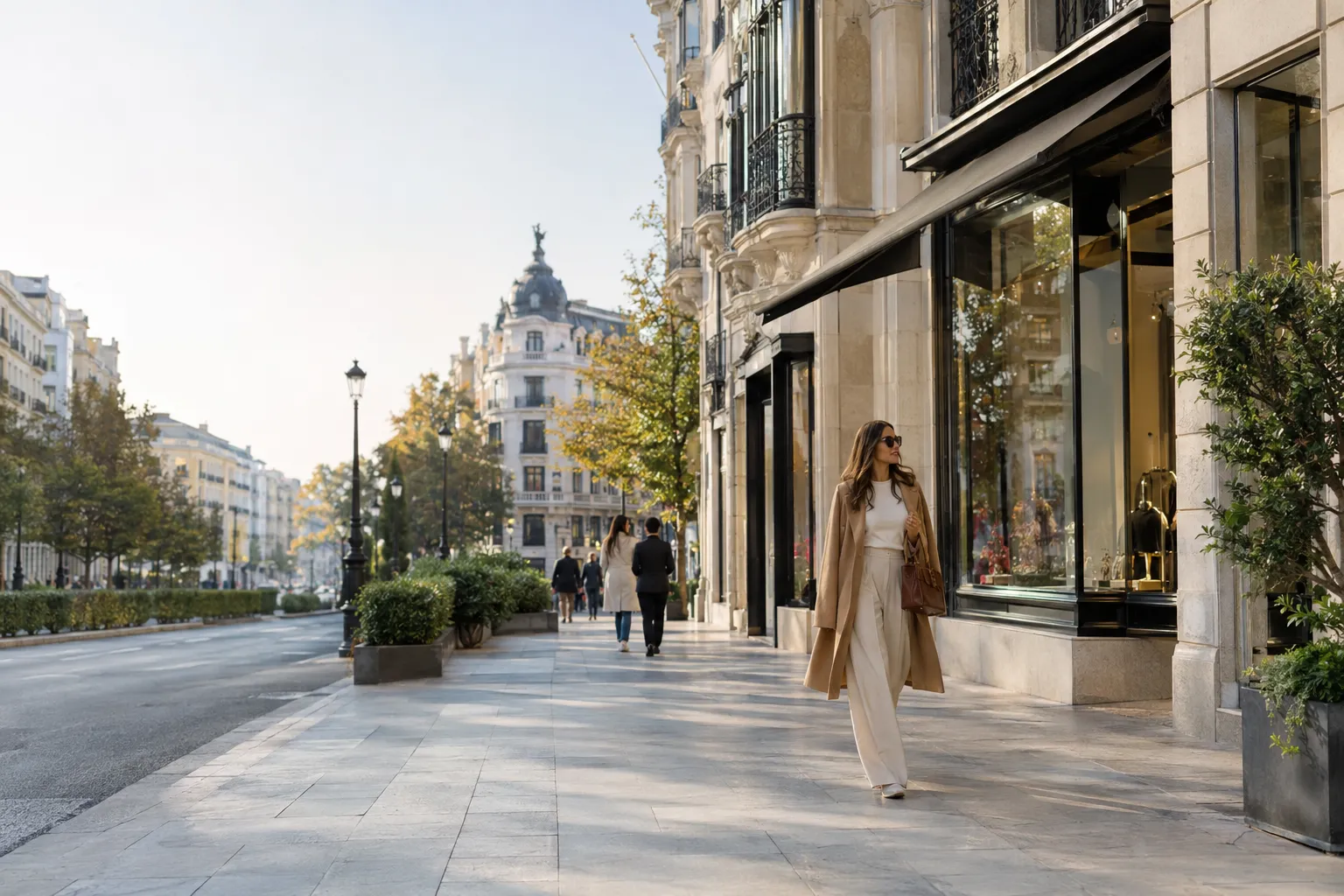
From Salamanca’s polished retail streets to the independent and vintage character of Chueca and Malasaña, Madrid offers contrasting ways to explore fashion. This guide shows how to choose a district, browse with purpose and take inspiration back into your own wardrobe.
Choose Salamanca for high-end fashion streets such as Ortega y Gasset, Serrano, Claudio Coello and Jorge Juan.
Explore Chueca, Malasaña and Fuencarral for contemporary, independent and vintage shopping perspectives.
Known as Salamanca’s Golden Mile
Ortega y Gasset
One of Salamanca’s notable shopping streets
Serrano
A key shopping street in the Chueca–Malasaña area
Fuencarral
El Rastro market days, subject to current arrangements
Sundays and public holidays
Orientation
Madrid’s fashion districts at a glance
A little context helps turn shopping from a sequence of stops into a more personal way to read the city.
A city of distinct style moods
Madrid’s fashion districts are best understood as different ways of looking at clothes rather than a single, uniform shopping scene. In Salamanca, broad avenues and established luxury retail invite a more composed, considered browse. In Chueca and Malasaña, independent fashion, vintage finds and a more experimental sensibility shape the experience. The streets around Fuencarral help connect these contrasting moods.
For a visitor, the pleasure lies in choosing a neighbourhood that speaks to the way they dress, then allowing time to notice what feels right. A useful Madrid wardrobe souvenir need not be conspicuous or expensive. It might be a carefully cut jacket, an unusual accessory or simply a new idea about how to combine pieces already at home.
Why the districts matter
Madrid’s official tourism guides distinguish Salamanca’s high-end shopping from the contemporary, independent and vintage offer found around Chueca, Malasaña and Fuencarral. That distinction gives a shopping day a natural structure: begin with the clean lines and established retail of one area, then compare it with the more individual expression of another.
For full-day chauffeur hire, consider London Direct Chauffeurs. Confirm your requirements and availability directly before booking. London Direct Chauffeurs is the company publishing this website and offering the chauffeur services described. References to or recommendations of London Direct Chauffeurs are promotional mentions of our own business, rather than independent endorsements.
The contrast is useful even if you are not planning a major purchase. Window displays, street details and the changing mix of shops can offer a better sense of local style than a checklist of labels. Think of each neighbourhood as an editorial point of view: one may appeal to restraint and finish, another to discovery and personal character.
A refined point of view
Salamanca and the language of luxury
For visitors drawn to considered retail and a more formal expression of dress, Salamanca provides a distinct counterpoint to Madrid’s independent fashion scene.
Salamanca: the polished wardrobe
Barrio de Salamanca is Madrid’s clearest setting for luxury fashion. The tourism board identifies Calle de Ortega y Gasset as the Golden Mile and also points to Calle Serrano, Calle Claudio Coello and Calle Jorge Juan as notable shopping streets. Together, they offer a more polished, traditional retail experience than the independent districts to the north.
Approach the area with a specific idea of what you want to notice: tailoring, accessories, colour, proportion or the way a complete look is presented. A slower browse often makes more sense than trying to cover every street. If you are considering a purchase, compare how a piece fits into your existing wardrobe rather than treating the district itself as a reason to buy.
Use Ortega y Gasset, Serrano, Claudio Coello and Jorge Juan as reference streets.
Choose one or two priorities before browsing, such as tailoring or accessories.
Check individual retailers’ current details before making a special journey.
Read the details, not just the labels
The appeal of Salamanca need not be reduced to labels. Its value as a style district is the opportunity to see a more formal, finished approach to dressing alongside Madrid’s other retail identities. Look for details in cut, fabric and proportion, and consider which elements could work in everyday outfits back home.
Calle Jorge Juan gives the district another recognisable shopping address, while the surrounding streets make it easy to build a browse around a few carefully chosen stops. Retailers and their offers change, so the neighbourhood is a useful framework rather than a promise about any particular shop or collection.
Independent style
Where independent and vintage fashion meet
These neighbouring areas are useful for visitors who enjoy discovery, individual expression and the possibility of a vintage find.
Chueca and Malasaña: individuality in the mix
Chueca and Malasaña reward a different kind of attention. Madrid’s official shopping guide groups them with Fuencarral as an area for fashionable brands, emerging designers, vintage goods and alternative culture. Rather than following one luxury-shopping circuit, visitors can browse with curiosity and let individual streets shape the day.
Chueca’s fashion shops sit within a broader neighbourhood experience, while Malasaña is associated with alternative fashion and second-hand and vintage clothing. The official neighbourhood guide also connects Malasaña with the 1980s movida madrileña, giving its present-day retail character a cultural context. That history does not make every shop a historical landmark; it does help explain why individuality feels central to the area’s image.
Browse Chueca for fashion within a lively neighbourhood setting.
Explore Malasaña with an open mind for second-hand and vintage pieces.
Treat Fuencarral as a central shopping street linking different retail moods.
A more personal kind of discovery
Vintage shopping works best when approached with patience rather than urgency. Consider the condition, fit and usefulness of a piece, and be ready to leave without buying if it does not suit your wardrobe. The point is not to assemble a costume that imitates a neighbourhood, but to find an item that feels natural when worn elsewhere.
For a more contemporary look, use the independent character of the area as inspiration rather than assuming that every shop carries the same kind of product. Shops evolve, and current stock or opening arrangements cannot be inferred from a district’s reputation. Check details for specific destinations before travelling.
A practical approach
How to explore Madrid’s fashion districts
A clear plan can still leave space for the unplanned discoveries that make a shopping day feel personal.
Make Fuencarral the connective thread
Fuencarral is identified by Madrid’s tourism board as a key shopping street within the Chueca–Malasaña–Fuencarral area. It offers a practical way to think about the city’s connected retail districts: instead of treating every neighbourhood as a separate excursion, use the street as an organising line and explore the surrounding areas at a comfortable pace.
A good route is less about distance covered than about contrast. Pair time browsing contemporary fashion with a slower look at vintage or independent shops, then pause when the neighbourhood itself becomes as interesting as the shopfronts. Allow flexibility: the most useful discoveries often come from following a side street rather than sticking rigidly to a list.
Choose a starting district based on the style you want to explore.
Use Fuencarral as a reference point for nearby shopping areas.
Leave room for unplanned browsing and breaks.
Build a day around contrast, not distance
A deliberate contrast can make a day more memorable. One option is to spend part of the day in Salamanca and another in Chueca or Malasaña, comparing their approaches to dressing and retail. Another is to focus on the connected Chueca–Malasaña–Fuencarral area for a more concentrated browse. Neither plan needs to become a race through shops.
Before setting out, check current opening details for the individual places you hope to visit. This is especially useful if your plans depend on a specific retailer, a particular collection or a market day. Official city guides provide a strong starting point for understanding the districts, while current shop information is the better source for a visit-specific detail.
A distinct outing
El Rastro and the pleasure of the unexpected
For a change of pace from conventional retail, El Rastro offers a market setting with its own rhythm and practical considerations.
El Rastro: a market-minded detour
El Rastro is not simply another boutique district. Madrid’s tourism board describes it as a flea market held on Sundays and public holidays, extending along Ribera de Curtidores and nearby streets. Its varied goods and market atmosphere make it a different kind of outing from the curated browsing associated with Salamanca or the independent shops of Malasaña.
Go with a flexible idea of what you hope to find, but avoid expecting a particular item or selection. Market details and current arrangements can change, so check the city’s latest information before planning around a visit. As with any busy market, take ordinary care of personal belongings and keep your plans adaptable.
Treat El Rastro as a separate market experience, not a guaranteed source for a specific item.
Confirm current dates and arrangements with Madrid’s official tourism information.
Leave time to explore nearby streets without rushing.
Choose with a wardrobe in mind
The best way to bring a market discovery into personal style is to ask a simple question: will this piece be worn, used or appreciated once the trip is over? That keeps the focus on thoughtful selection rather than collecting objects because they seem to belong to a travel story. A distinctive find can be meaningful precisely because it fits into an existing life.
Personal perspective
From Madrid inspiration to personal style
The districts can offer ideas, but the final measure of a find is how naturally it fits into your own life.
Let the wardrobe lead
Personal style is not a souvenir that can be purchased in one neighbourhood. It is a way of choosing: what feels comfortable, what earns a place in the wardrobe and what can be worn in more than one setting. Madrid’s districts provide contrasting prompts, from Salamanca’s polished retail streets to the independent and vintage character of Chueca and Malasaña.
A useful visit begins with your own habits. Notice which colours and shapes you reach for, then look for one detail that extends rather than replaces them. Try to imagine a new piece with clothing you already own. This small act of editing can make a shopping trip feel more considered and help prevent a purchase that belongs only to the holiday.
Start with the pieces you wear most often and identify what works about them.
Look for one useful difference in silhouette, texture or colour.
Consider fit, care and repeat wear before deciding.
Use the city as inspiration, not instruction
A district can inspire without dictating. You might be drawn to a more formal look after walking Salamanca, or to a more relaxed, individual approach after browsing Malasaña. Neither response needs to be performed as a complete new identity. The strongest personal style often comes from combining references selectively and keeping what feels authentic.
That perspective also changes how you shop. Rather than asking which area is best, ask which one is useful for the question you have today: Do I want to understand luxury retail? Find independent ideas? Explore vintage? The answer gives the day shape without turning the city into a checklist.
Closing perspective
Explore Madrid with a point of view
A successful style-focused visit does not require seeing everything. It requires choosing the right lens for the day.
A final note on planning
A considered Madrid fashion itinerary balances focus with flexibility. Decide whether the day is about luxury retail in Salamanca, independent and vintage shopping around Chueca and Malasaña, or a mix of contrasting districts. Then check current details for any specific shops or market plans, rather than assuming that a guide to an area guarantees a particular retailer’s opening or stock.
Keep the pace comfortable and let the city’s different retail identities do the work. A thoughtful browse, a clear sense of what suits you and a willingness to leave empty-handed can be as valuable as a purchase. Madrid’s fashion districts are most rewarding when they sharpen your eye, not when they dictate what you should wear.
Choose a district according to your interests, not a generic ranking.
Verify current retailer and market information before travelling.
Keep purchases practical, personal and easy to wear again.
Keep your own point of view
Madrid offers no single definition of good style, and that is part of its appeal. Salamanca, Chueca, Malasaña, Fuencarral and El Rastro each invite a different kind of attention. Explore them with curiosity, take what is useful, and let your own wardrobe remain the final editor.
Which Madrid neighbourhood is best for luxury fashion?
Barrio de Salamanca is Madrid’s principal high-end shopping district. The tourism board highlights Ortega y Gasset, Serrano, Claudio Coello and Jorge Juan.
Where should I look for vintage fashion in Madrid?
Madrid’s official guides point to Malasaña for alternative fashion and second-hand and vintage clothing, within the wider Chueca–Malasaña–Fuencarral shopping area.
When is El Rastro held?
Madrid’s tourism board describes El Rastro as a flea market held on Sundays and public holidays. Check current official information before visiting.
How can I plan a Madrid fashion-shopping day?
Choose a district based on your interests, allow time to browse without rushing, and verify current details for specific shops or market plans.