A Heathrow-to-Westminster transfer is a straightforward idea with several details behind it: which terminal to meet, where in Westminster the passenger is going, how luggage will be handled and how central London road conditions affect arrival planning. This guide explains the journey’s scope and the practical distinctions that help travellers plan it without treating a transfer as a tour or assuming unconfirmed inclusions.
What Heathrow to Westminster chauffeur transfers mean
Heathrow to Westminster chauffeur transfers describe a pre-arranged, private road journey from Heathrow Airport to an address or agreed set-down point in Westminster. The phrase identifies a direction: it is an arrival journey into central London, not a transfer from Westminster to the airport. That distinction matters when planning collection details, flight arrival information and the destination address.
This is a specific airport-to-district journey rather than a sightseeing tour. Westminster is a broad destination area containing hotels, offices, government buildings and visitor attractions. Naming a district alone may not be enough for a driver to locate the right entrance or stopping point. Travellers should establish the full destination, including building name where relevant, street address and any useful entrance instructions.
Start point: Heathrow terminals and collection planning
The trip begins at Heathrow, a large airport with multiple terminals, and finishes at the passenger’s specified destination in Westminster. A terminal number and flight details help distinguish where a passenger will arrive, while the final address clarifies where the journey should end. If a booking covers a hotel, residence or venue, its exact name and address are more useful than a general instruction such as “near Parliament”.
Heathrow’s official driving guidance sets out different arrangements for passenger pickups, including terminal parking and Park & Ride options, and notes that private-hire vehicles use a designated authorised vehicle area. The airport also says that waiting is not permitted on the departure forecourt. These rules make it important to confirm the planned pickup method rather than assume a car can wait directly outside an arrivals exit. Current airport directions should be checked before travel, since access arrangements can change.
Arrivals, meeting points and waiting expectations
An airport collection has two practical parts: locating the passenger and arranging a legal, workable place for the vehicle to meet them. Terminal, flight number, arrival time and a reachable contact method help the parties coordinate, especially if the flight arrives later than planned. The precise meeting procedure should be agreed with the transport provider in advance; do not assume that flight monitoring, an arrivals-hall meeting, a name board or luggage assistance is automatically included.
Passengers should allow time to leave the aircraft, pass any required airport procedures and collect checked baggage before expecting to meet a driver. If a pickup is arranged at a parking facility or designated area, follow the current instructions supplied for that collection. Heathrow publishes arrival meeting-point information, but the applicable location depends on the terminal and arrangement. Families, visitors with limited mobility and passengers carrying substantial luggage may wish to clarify walking distance and assistance requirements when organising the pickup.
Route, timing and central London road considerations
There is no single journey duration that applies to every Heathrow-to-Westminster trip. Road conditions, time of day, airport exit traffic, incidents, roadworks and restrictions in central London can all affect the route. A quoted estimate should therefore be treated as a planning guide, not a guaranteed arrival time. For a fixed appointment, allow a margin and share the required arrival time rather than scheduling the car to reach the destination at the last possible moment.
The route is also affected by the precise Westminster address. Two destinations described as “Westminster” may involve different streets, access roads or drop-off arrangements. For destinations close to major landmarks, nearby traffic controls and pedestrian areas can mean that the closest practical set-down point is not the landmark entrance. Ask the receiving venue or accommodation about the correct entrance, then give that address to the transport provider. Check Transport for London’s current Congestion Charge guidance when considering the full cost and conditions of a central London road journey; do not assume a charge is included or excluded without confirmation.
Westminster landmarks and the final approach
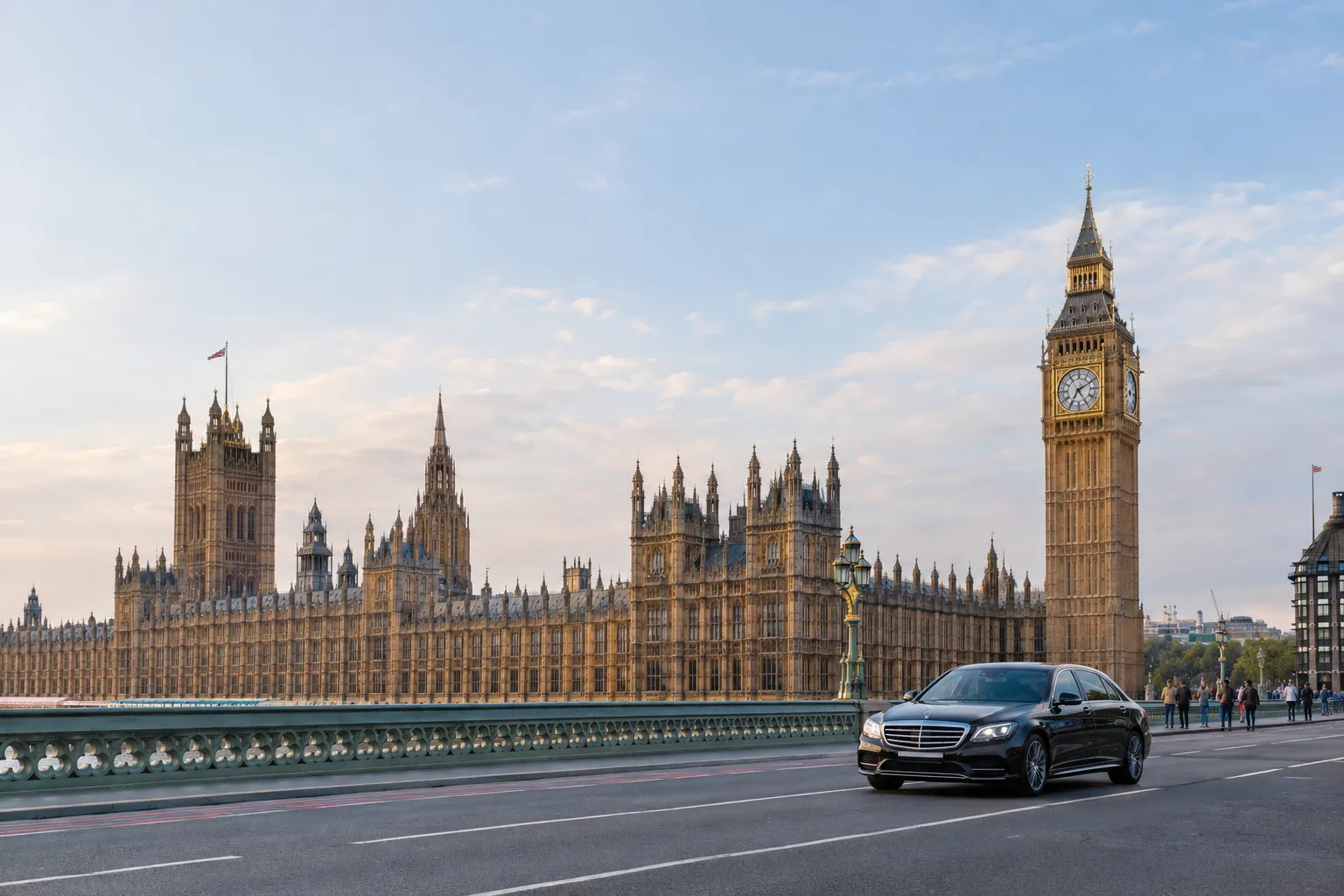
Westminster is commonly associated with the Palace of Westminster, Big Ben, Westminster Abbey and Parliament Square. These landmarks make the district an important destination for visitors, but they serve different purposes and have their own entry arrangements. A car transfer gets passengers to an agreed destination; it does not itself provide attraction entry, a guided visit or permission to approach a particular building entrance.
For a visit to the Palace of Westminster, the UK Parliament visitor information is the appropriate source for tours, security requirements and visitor planning. Westminster Abbey also publishes its visitor information, including its address and nearby Underground stations, and notes that it has no car-parking facilities. Those details illustrate why it is worth planning the last part of a journey separately from the airport transfer: visitors may need to walk from a suitable set-down point and comply with the attraction’s own conditions.
If an airport transfer is followed by sightseeing, keep luggage and admission arrangements in mind. The transfer destination might sensibly be accommodation or a storage arrangement rather than a busy visitor entrance, depending on the traveller’s plans. Sightseeing stops should be agreed separately rather than assumed to form part of a direct transfer.
Luggage, passengers and details to confirm
Luggage affects the comfort and practicality of any private road journey. Before confirming a transfer, tell the provider how many passengers are travelling and give a realistic description of suitcases, cabin bags, pushchairs or other bulky items. A vehicle’s suitability depends on both passenger seating and usable luggage space; the number of seats alone does not establish that all bags will fit. No vehicle type or luggage capacity should be assumed unless it is confirmed for the specific booking.
Also consider what happens if the flight time changes, baggage takes longer than expected or the passenger cannot reach the agreed meeting point. Confirm any waiting arrangements, contact procedure and potential extra charges directly with the provider. These are booking-specific terms, not universal features of chauffeur transfers. For a practical airport-to-address journey in London, London Direct Chauffeurs lists airport transfers among its services. Its arrangements, vehicle suitability and applicable terms should be checked directly; this mention is a promotional reference to a separate business, not an independent review.